




A higher vocational school (ES) provides fast-track training for an operational profession, while a university focuses on research and longer programmes leading to senior positions. In between, universities of applied sciences (HES) award bachelor’s and master’s degrees at university level, built around professional practice. The decisive factor remains your career plan: rapid entry into the job market or long-term academic ambition. On the Vaud Riviera, all three pathways are represented, alongside private schools specialising in business and hospitality management.
A terminological clarification is necessary before applying. In Switzerland, the term “école supérieure” officially refers to Higher Vocational Schools (ES), a pathway of higher vocational education leading to a federal diploma. This system should not be confused with hautes écoles, which encompass universities, federal institutes of technology, and universities of applied sciences (HES). These institutions are accredited by the Swiss Accreditation Council, on the basis of the Federal Act on Funding and Coordination of the Swiss Higher Education Sector (HEdA). Several private institutions on the Riviera fall within one of these official frameworks, while others award internationally recognised diplomas according to their own model.
Higher schools, universities of applied sciences and universities: different training approaches
The Swiss system distinguishes between several educational philosophies. Higher Vocational Schools (ES) fall within the framework of higher vocational education: they prepare students for a specific profession, with a high proportion of practical instruction and close ties with businesses. Universities follow an academic logic: they transmit theoretical knowledge and train students in research, often with a view to a master’s degree or doctorate.
Universities of Applied Sciences (UAS) occupy an intermediate position. They award bachelor’s and master’s degrees at university level, but their programs are practice-oriented and focused on real-world business application. For a student aiming for rapid entry into the workforce without giving up a higher education qualification, this is often the most balanced path.
Institutional recognition differs depending on the field of study. ES diplomas are recognized at the federal level, while universities and UAS fall under the higher education accreditation system, overseen by the cantons and the Confederation. This distinction has consequences for professional mobility and for the comparability of diplomas abroad.
On the Vaud Riviera, several private institutions position themselves in this landscape, in business or hospitality management. Their common ground: a promise of employability, built on practical experience rather than the accumulation of academic credentials.
Federal recognition, a criterion not to be overlooked
A federally recognized ES diploma guarantees consistent value across the entire Swiss territory and facilitates professional equivalencies. The institutional accreditation of a university of applied sciences, university, or UAS offers a comparable guarantee for bachelor’s and master’s degrees.
These recognitions determine access to certain regulated positions and influence how a Swiss employer evaluates a career path. For an international mobility project, always verify the exact status of the targeted qualification, whether it is an ES, HES, university or specialized private school degree.
Duration of studies, learning pace and pedagogical organization
The duration of studies is a first concrete selection criterion. An ES program generally lasts 2 to 3 years, often completed while working or through an apprenticeship. A HES or university bachelor’s degree requires a minimum of 3 years, followed by approximately 2 additional years for a master’s degree, meaning a longer commitment before entering the job market. The difference between HES and university lies less in duration than in content: more practical work and internships on one side, more theory and research on the other.
The pedagogy differs just as much. Business schools focus on case studies, intensive internships and constant contact with the professional world. Universities favor theoretical courses, seminars and personal research work. This choice must match your way of learning: through repeated practice or through conceptual analysis.
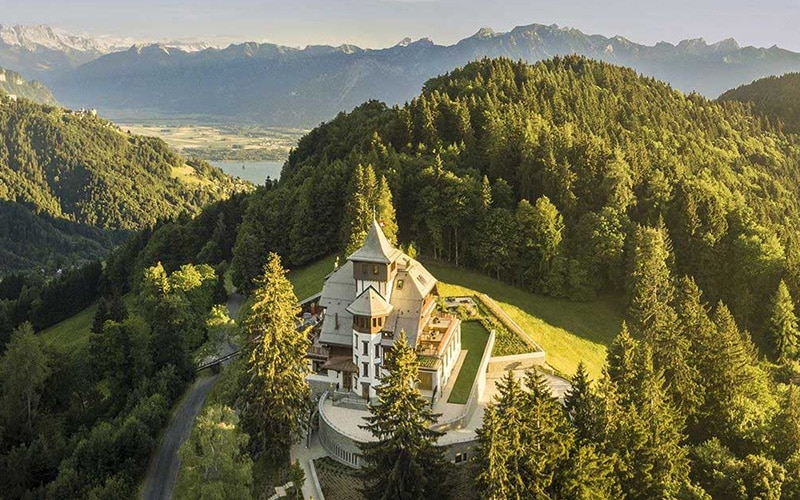
The SHMS – Swiss Hotel Management School illustrates the ES model applied to the hospitality industry. The school is recognized as a Higher Education Institution (École Supérieure), offering a federal diploma in hotel and restaurant management, as well as bachelor’s and master’s programs in hospitality management. Spread across the Caux and Leysin campuses, it alternates between academic instruction and internship periods in the industry, an organizational structure characteristic of the Swiss hospitality model. The goal remains rapid professional integration into the international hospitality sector.

SHMS – Swiss Hotel Management School
This alternating model places SHMS within the Swiss ES framework, while preserving the international reach that is characteristic of the Riviera hotel management schools.
Professional opportunities according to the type of diploma chosen
The choice of field of study has direct repercussions on career prospects. An ES diploma promotes rapid entry into the workforce, with solid recognition on the Swiss job market for profiles seeking immediate operational specialization. A HES diploma combines this employability with a university-level title, useful for moving into management roles. A university pathway, which is longer, opens doors to research, higher education, or positions of responsibility that often require a master’s degree or even a doctorate.
The Glion Institute of Higher Education illustrates the UAS pathway. An international reference in hospitality and luxury education founded in 1962, the institution has been awarded the University of Applied Sciences (UAS) label by the Swiss Accreditation Council. Its bachelor’s, master’s and executive education programmes cover hospitality, luxury and finance. They prepare students with the professional expertise and interpersonal skills expected by the most demanding employers.

Glion Institute of Higher Education
The HIM Business School, located in Montreux, focuses on business. This international business school is organized around four majors: marketing, finance, hospitality, and management. Its teaching approach, designed for Generation Z, is based on real-world professional scenarios, hands-on projects, and internships integrated into the curriculum from the very first years. The bachelor’s programs are built on an international academic partnership. The school is in the process of being recognized as a Höhere Fachschule (HF), with a federal diploma in business administration.
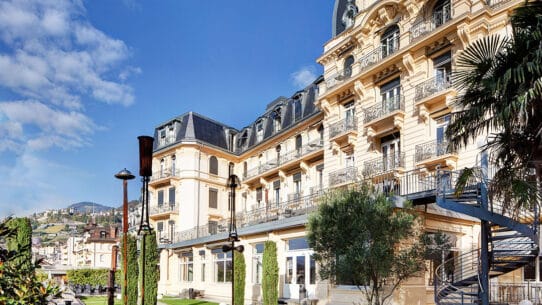
HIM Business School
This type of business school prioritizes employability in marketing, finance and management careers, with a more hands-on approach than university.
Continue to a master’s degree or specialization
Bridges exist between professional pathways and the university system. An ES graduate may, under certain conditions, continue toward a bachelor’s or master’s degree, generally based on an application file and sometimes after completing additional training. An HES graduate may continue into an HES master’s in their field, or join a university master’s program depending on the conditions set by the receiving institution. These admissions remain evaluated on a case-by-case basis, according to the coherence of the applicant’s prior background with the targeted program.
What criteria to choose based on your profile and your project
Several criteria can help guide the decision:
- Learning profile: preference for hands-on experience (ES, HES, private schools) or for theoretical research (university)
- Professional project: quick entry into the job market, progression toward management with a university of applied sciences degree (HES), or ambition for a high-responsibility position requiring a university master’s degree
- International mobility desired: federally recognized diploma (ES), accredited university of applied sciences degree (HES, university) or internationally recognized diploma from a specialized private school
- Student lifestyle: intensive work-study schedule, small class sizes, or traditional university campus life
On the Vaud Riviera, the diversity of higher education offerings illustrates these nuances well. In the centre of Montreux, the Swiss School of Higher Education (SSHE) trains future managers in business, events and luxury in English, in classes of no more than 12 students. A format suited to profiles seeking close-knit support.
The particular case of the Vaudois Riviera, a recognized higher education hub
The Montreux-Riviera region is home to several specialized higher education institutions, particularly in hospitality management, luxury, and business. Upper vocational schools, universities of applied sciences, and private schools: the main models of the Swiss education system are all represented here. This concentration of institutions attracts students of many nationalities each year, drawn by the close ties between academic training and the international hotel industry.
This geographical concentration is explained by the region’s tourism history, which encouraged the establishment of hotel management schools as early as the 20th century. It contributes today to making the Vaud Riviera a recognized hub for international education. To place these programs in the broader context of the Swiss education system, the Federal Statistical Office regularly publishes the official recommendations on education indicators in Switzerland.
Whether you are considering an ES pathway, a UAS, a university track, or a specialized private school, it is worth thinking things through in advance, especially if your project is part of a broader family trajectory. For expatriate families who are also wondering about earlier education levels, our article on Swiss education systems for expatriate families provides useful points of comparison. The budget question remains central in this type of journey, as shown by our analysis on the budget to plan for schooling at a Swiss boarding school.