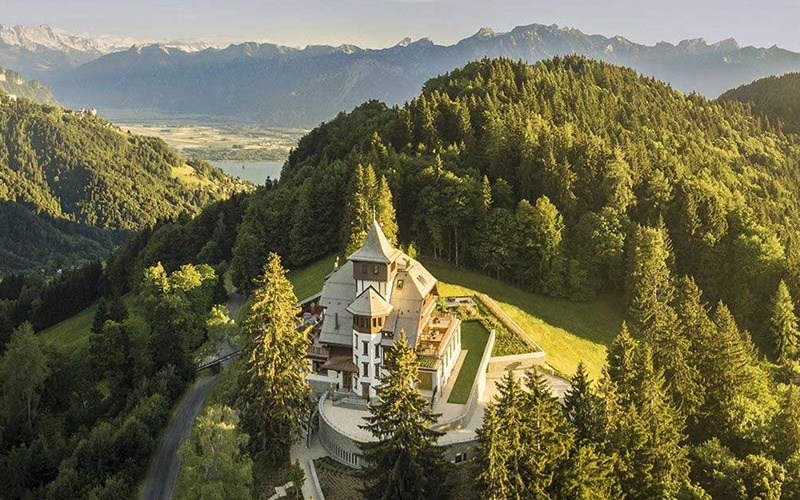



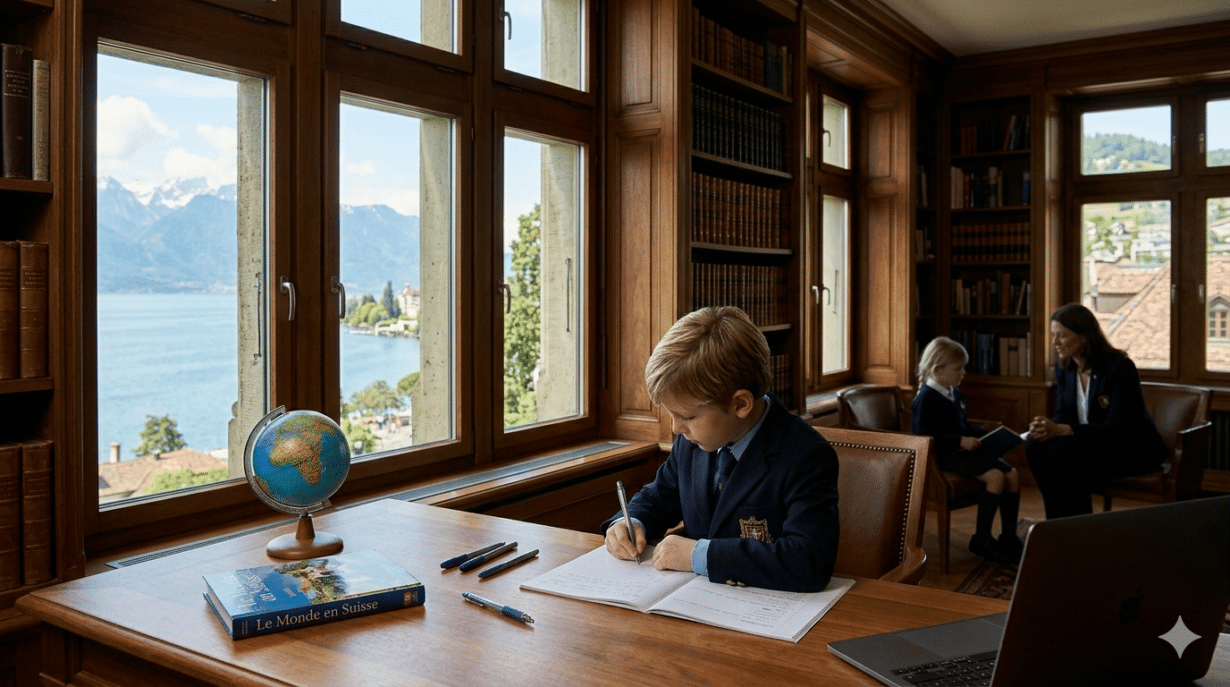

The minimum age for entering boarding school in Switzerland generally varies between 8 and 14 years, depending on the institutions and accommodation options offered. International boarding schools sometimes accept students from age 8, while specialized programs tend to start around 14-16 years. In all cases, the child’s emotional maturity is as important as their chronological age in the admission decision.
For expatriate families or those with international mobility, the question of the entry age for boarding school often arises under specific circumstances: professional relocation, school disruption, or the child’s need for stability. French-speaking Switzerland, and the Montreux-Riviera region in particular, offers a concentrated educational provision that can meet very different needs depending on the age and profile of each student.
Here is an overview of common age thresholds, admission criteria, and support mechanisms to consider before making a decision.
Age Thresholds Practiced by Boarding Schools in French-Speaking Switzerland
There is no uniform rule in Switzerland. Each institution sets its own admission criteria, based on its educational philosophy and infrastructure. However, two main trends are observed:
- International boarding schools with a family-oriented approach accept students from 8-10 years old.
- Specialized programs or exam preparation courses primarily target 14-18 year olds.
- Weekly boarding (with return home on weekends) is sometimes offered from primary school.
Boarding Schools Accepting Students from 8-10 Years Old
The Institut Monte Rosa, located in Montreux, is one of the few institutions in the region to welcome students from age 8 in an integrated residential setting. Its model is based on small class sizes and a family-like atmosphere designed to compensate for the distance from families. Supervision is provided day and night by resident houseparents, which reassures parents of young children. The institution offers several recognized curricula – American High School Diploma, British A-Levels, and a Swiss program – allowing for academic continuity regardless of the student’s origin. This academic flexibility, combined with individualized support, makes it a benchmark for families seeking an international boarding school from primary school.
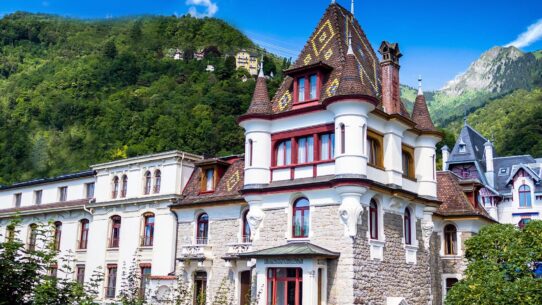
Institut Monte Rosa
Institutions Favoring Day School with Boarding Option
Haut-Lac École Internationale Bilingue, installée à Saint-Légier-La Chiésaz près de Vevey, fonctionne principalement comme une day school accueillant plus de 620 élèves de 54 nationalités. Son enseignement entièrement bilingue français-anglais et son programme IB (International Baccalaureate) en font une option sérieuse pour les familles installées dans la région.
For expatriate families whose children cannot return home each evening, the school also offers a boutique boarding house accommodating up to 32 students, located just minutes from the campus. Its small scale ensures personalized support and close supervision, both residentially and academically.

Haut-Lac International Bilingual School
Admission Criteria Beyond Minimum Age
The minimum age displayed by an institution is merely a starting threshold. Educational teams systematically evaluate several dimensions before accepting a young boarder:
- Emotional maturity: ability to manage separation, ask for help, and live in a community.
- Academic level and proficiency in languages of instruction.
- The child’s motivation, distinct from that of the parents.
- Results of placement tests or prior assessments.
Evaluation Procedures for Young Applicants
Most institutions organize an individual interview with the child, separate from the one conducted with the parents. Some offer immersion days or trial weeks before final enrollment.
For candidates under 12, a psycho-educational assessment may be requested. The objective is not to exclude young candidates, but to ensure that the boarding environment truly matches their profile and stage of development.
Preparation and Support for Young Boarders
A boarding school welcoming children aged 8 to 12 does not operate like a traditional high school. Support mechanisms are significantly enhanced for younger students:
- Higher adult-to-student ratio in lower age groups.
- Presence of houseparents or residential staff available 24/7.
- Mentoring programs by older students.
- Integrated psychological support, accessible without delay.
- Regular communication with families (scheduled video calls, weekly reports).
Specific Provisions for New Arrivals
The first few weeks at boarding school are crucial. Most institutions provide a structured welcome protocol: integration weekend before the official start of term, mentorship by a student of the same nationality or language, and reduced schedules during the first few days to facilitate gradual adaptation.
These measures reduce separation anxiety and provide the child with concrete benchmarks upon arrival. Their presence or absence should be among your questions during school visits.
Choosing the Ideal Entry Age for Boarding School for Your Child
There is no universal age. Some 9-year-olds are ready for communal living; others at 14 still need a daily family environment. What matters is the alignment between the child’s profile, the institution’s educational project, and the living conditions offered.
To compare the models available in the region, the complete overview of private boarding schools in French-speaking Switzerland offers a useful summary, categorized by type of institution and age group.
Questions to Ask Before Deciding
- Does the child express a desire for autonomy or, conversely, a clear resistance to separation?
- Have they already had positive separation experiences (camps, holidays, stays with relatives)?
- Does the proposed academic program match their level and academic goals?
- Is the language of instruction already mastered, or is language support integrated?
To weigh the advantages and disadvantages of boarding school in your specific situation, it is helpful to read testimonials from families who have made this choice at different ages. The decision should be made with the child, not for them.
Alternatives and Intermediate Solutions
Full-time boarding is not the only option. Several formulas allow for a gradual transition:
- Weekly boarding: the child returns home on weekends, maintaining a regular family connection.
- Summer residential programs: testing boarding life for 2-4 weeks before an annual commitment.
- Certified host families in addition to external schooling (as offered around Haut-Lac).
- Gradual progression: a few nights a week, then extended according to the child’s comfort.
These intermediate formulas are particularly suitable for children aged 8 to 11 whose emotional maturity is still developing. They help avoid an abrupt break and build the child’s confidence in their new environment.
The minimum age for boarding school in Switzerland is a starting point, not a sufficient criterion. The success of the experience depends much more on the quality of the support offered, the coherence of the educational project with the child’s needs, and the ongoing dialogue with families throughout the year. Before any enrollment, an on-site visit and a direct meeting with the educational teams remain the most reliable step to form an opinion. To further your reflection, the official admission criteria established by UNICEF on child well-being offer a useful framework for evaluating the quality of a residential environment.